
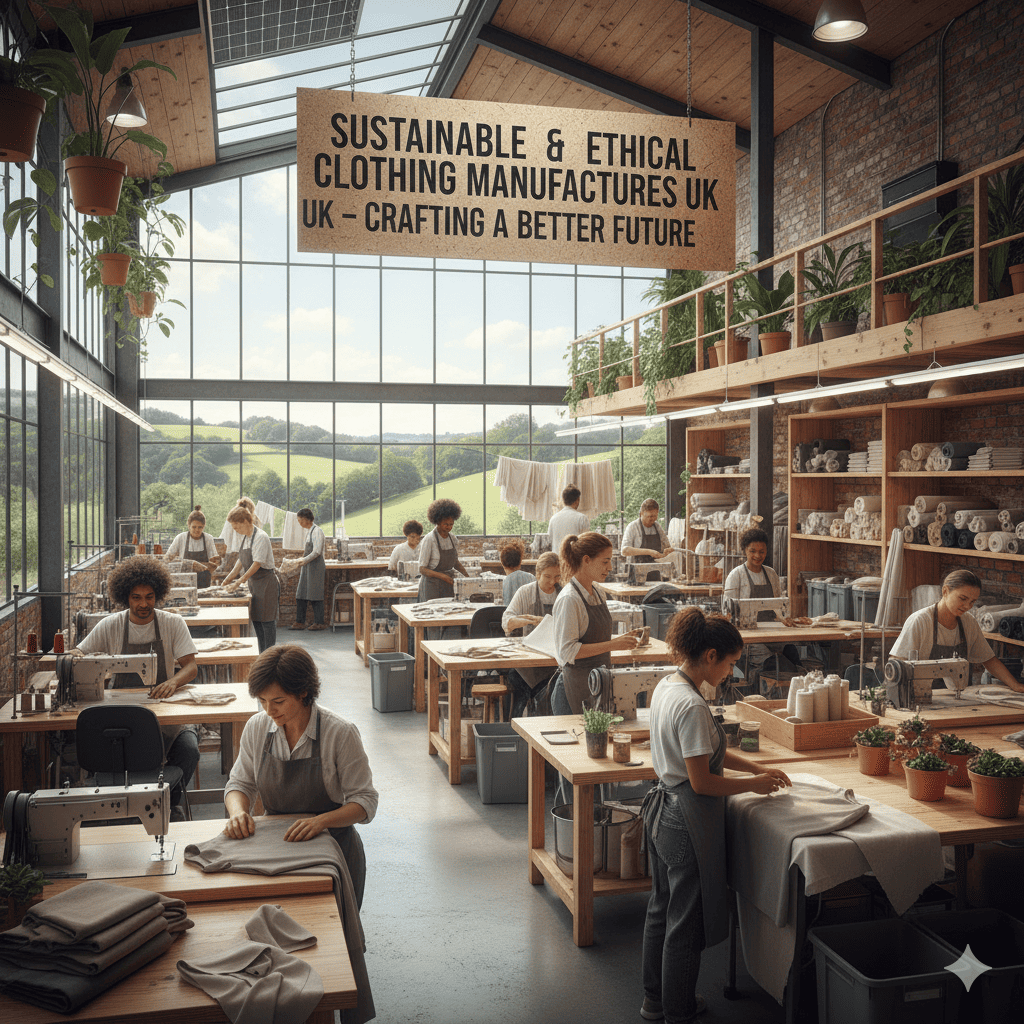
Caring about sustainability is not the same as manufacturing sustainably. Most UK clothing brands now claim green credentials. Fewer than 200 UK manufacturers can back those claims with a verifiable certification. (Source: Textile Exchange, Textile Industry Report, 2024)
That gap — between stated values and documented practice — is where brands get burned. Buyers get sued. And consumers lose trust.
This guide does not celebrate your good intentions. It shows you exactly what genuine sustainable clothing manufacturers UK look like, what certifications mean in practice, how to calculate your real carbon saving by manufacturing domestically, and how to spot a greenwash before it costs you a rebrand.
Contents
- 0.1 Quick Answer
- 0.2 What “Sustainable Manufacturing” Actually Means — and What It Doesn’t
- 0.3 What Makes a Manufacturer Truly Sustainable? The Criteria That Matter
- 0.4 Certifications Guide: What Each One Covers and What It Does Not
- 0.5 Ethical Manufacturing Standards in UK Clothing Production [STAT]
- 0.6 Recycled & Upcycled Clothing Production: What the Supply Chain Actually Looks Like
- 0.7 Organic Cotton vs Conventional: The Numbers That Determine Your Choice [TABLE]
- 0.8 Carbon Footprint: UK vs Offshore Manufacturing — The Real Numbers [STAT]
- 0.9 Case Study 1: Switching to Sustainable UK Production
- 0.10 Greenwashing: Red Flags to Avoid [MISTAKES]
- 0.11 Cost Reality: The Sustainable Premium Explained
- 0.12 Case Study 2: Cost Comparison — Before and After Sustainable UK Production
- 0.13 The Silk Routes Approach to Ethical Manufacturing
- 1 What Does Genuine Sustainable Manufacturing Look Like?
- 1.1 Certification Comparison
- 1.2 Carbon Footprint: UK vs Offshore
- 1.3 Organic vs Conventional vs Recycled Cotton
- 1.4 Greenwashing Checklist
- 1.5 The Cost Reality of Sustainable UK Production
- 1.6 FAQ
- 1.6.1 What certifications should I look for in a sustainable clothing manufacturer UK?
- 1.6.2 How much more does sustainable UK manufacturing cost compared to offshore production?
- 1.6.3 Is UK clothing manufacturing automatically ethical?
- 1.6.4 What is greenwashing and how do I spot it in a manufacturer’s claims?
- 1.6.5 What is the difference between ethical and sustainable in clothing manufacturing?
- 1.6.6 Can small brands afford sustainable UK manufacturing?
- 1.7 Citations and Sources
Quick Answer
The UK has fewer than 200 manufacturers who can credibly claim sustainable or ethical credentials. A genuinely sustainable clothing manufacturer in the UK holds at least one verifiable certification — GOTS, OEKO-TEX Standard 100, Fair Trade, B Corp, or ISO 14001 — and will provide documentary evidence on request. UK production cuts your carbon footprint by up to 60% compared to sourcing from Bangladesh or China through reduced freight alone. Ethical standards cover both environmental output and labour practices: audited wages, safe conditions, no forced or child labour. This guide covers every major certification, exposes the top greenwashing tactics, and gives you the exact questions to ask before signing any production contract.
What “Sustainable Manufacturing” Actually Means — and What It Doesn’t
Most guides open by congratulating you for asking the question. Here is the reality: sustainable fashion supply chain is one of the most abused phrases in the industry.
Sustainable manufacturing has two distinct dimensions. Environmental sustainability covers materials, waste, water use, energy source, and carbon output. Ethical manufacturing covers labour — wages, hours, conditions, and supply chain transparency.
A factory can be environmentally certified and still pay poverty wages. A factory can be Fair Trade audited and still use virgin polyester for every garment. You need to check both tracks independently.
The UK Consumer Protection Act 2008 and the Competition and Markets Authority’s Green Claims Code (2021) now require that any environmental claim be accurate, clear, and substantiated. Vague claims — “eco-friendly,” “conscious collection,” “green manufacturing” — without evidential backing are legally actionable. (Source: Competition and Markets Authority, Green Claims Code, 2021)
Opinion: The brands most at risk are not the ones making outright false claims. They are the ones who genuinely believe their manufacturer is sustainable because it is British, without ever asking for a single document.
What Makes a Manufacturer Truly Sustainable? The Criteria That Matter
Before you look at certifications, understand the baseline criteria you are evaluating against.
A credible manufacturer should be able to provide documented answers to these questions, not verbal assurances.
Environmental criteria:
- What percentage of fabrics used are certified organic, recycled, or sustainably sourced?
- What is the factory’s water consumption per unit, and is wastewater treated before discharge?
- What energy sources power production — grid, renewable, mixed?
- What is the waste diversion rate, and where does off-cut material go?
Ethical criteria:
- Are workers paid at or above the Real Living Wage (currently £12.60/hour outside London, £13.85 in London as of 2024)? (Source: Living Wage Foundation, Real Living Wage Rates, 2024)
- Are working hours audited, and by whom?
- Is there a grievance mechanism workers can access without fear of dismissal?
- Is the factory’s supply chain visible two tiers up — meaning fabric mills and yarn suppliers?
Transparency criteria:
- Will the manufacturer share its audit reports with you?
- Is it registered on an open database such as the Open Apparel Registry?
- Does it list its certifications publicly with licence numbers you can verify?
A manufacturer who refuses any of these is telling you something. Take the answer seriously.
The document request that reveals the most: ask for the last full third-party audit report, unredacted. A reputable manufacturer will share it with a prospective client under a basic NDA. Refusal — or a claim that the audit is “confidential” — is a significant red flag. Audits are designed to demonstrate compliance. A manufacturer with nothing to hide shares them.
How to evaluate a factory visit versus a documentary audit: factory visits are useful for assessing culture, equipment quality, and scale. They are not a substitute for documentation. You cannot see wage slips, working hour records, or chemical inventories during a standard factory tour. A well-presented facility with friendly staff and a clean floor can still fail a wage audit. Always combine a site visit with a document request — and treat the document review as the primary evaluation, not the tour.
Slow fashion manufacturers in the UK typically operate at a different rhythm from fast-fashion volume production. Lead times of 6–10 weeks are standard. Sampling cycles are collaborative rather than rushed. This pace is itself an environmental factor: fewer sampling iterations means less waste fabric. Brands accustomed to fast-fashion production timelines should adjust expectations before approaching a slow fashion UK manufacturer, and understand that the slower pace is a feature of the ethical model, not a capability gap.
Certifications Guide: What Each One Covers and What It Does Not
Certifications are not interchangeable. Each covers a different scope. A brand that holds GOTS is not automatically ethical on labour. A B Corp-certified business is not automatically using organic inputs. The table below maps each major certification to what it actually audits.
| Certification | Scope | What It Covers | What It Does NOT Cover | Issued By | Renewal |
|---|---|---|---|---|---|
| GOTS (Global Organic Textile Standard) | Product + Factory | Organic fibre (min 70%), chemical processing, labour standards at factory level | Tier 2+ supply chain, energy source | GOTS-approved certifier | Annual |
| OEKO-TEX Standard 100 | Product | Harmful substance limits in finished textile | Production process, labour, carbon output | OEKO-TEX Association | Annual |
| Fair Trade Textile Standard | Factory labour | Wages, working hours, freedom of association, safe conditions | Environmental credentials, fibre sourcing | Fairtrade International | Annual |
| B Corp | Whole business | Governance, workers, community, environment, customers | Product-level fibre certification | B Lab | 3 years |
| ISO 14001 | Factory environment | Environmental management system, waste, energy, pollution | Labour, product-level fibre, wages | Accredited ISO body | 3 years |
| Bluesign | Fabric mill | Chemical safety, resource productivity, water/energy in dyeing | Labour, finished product, brand practices | Bluesign Technologies | Ongoing |
The single most common mistake brands make: treating OEKO-TEX Standard 100 as proof of sustainability. It confirms the finished fabric does not contain harmful substances. It says nothing about how the fabric was grown, dyed, or who made it.
If you need one certification to prioritise, GOTS is the most comprehensive for both fibre integrity and labour at factory level. If your manufacturer cannot provide a GOTS licence number you can check at global-standard.org, the certification does not exist.
Ready to discuss production requirements with a UK manufacturer who takes verification seriously? See our full range of services at silkroutes.co.uk/clothing-manufacturing-services/.
Ethical Manufacturing Standards in UK Clothing Production [STAT]
The UK garment sector has a documented compliance problem. A 2023 investigation by the Garment and Textile Workers Trust found that wage underpayment remained widespread in Leicester’s garment district, with some workers paid as little as £5 per hour — well below both the National Minimum Wage and the Real Living Wage. (Source: Garment and Textile Workers Trust, Leicester Garment Industry Monitoring Report, 2023)
This matters for one reason: ethical clothing manufacturers UK are not automatically ethical because they are UK-based. Geography is not an audit.
The three-tier verification model is what separates genuine ethical manufacturers from ones that simply operate in Britain.
Tier 1 is factory-level audit. This covers the cutting, sewing, and finishing facility you visit. Most brands stop here. It is not enough.
Tier 2 is fabric mill and trim supplier audit. This is where labour abuses and environmental violations most commonly occur. Fabric dyeing is chemically intensive. Yarn spinning is physically demanding. These facilities need independent verification.
Tier 3 is raw material sourcing. For cotton: was it harvested with forced labour? For wool: was animal welfare audited? For polyester: is it recycled (GRS certified) or virgin?
The brands that avoided scandal in the last five years are the ones who pushed verification to Tier 2 minimum. Those that relied on Tier 1 alone — even with a reputable UK manufacturer — found themselves exposed when their supply chain made headlines.
Specific counterintuitive insight: A smaller UK manufacturer with no certification but a transparent, auditable supply chain and published wage records is often a safer ethical partner than a larger certified factory where sub-contracting occurs.
What Fashion Revolution’s Transparency Index shows: the 2023 Fashion Transparency Index, which scores 250 major fashion brands on supply chain disclosure, found that 96% of brands scored below 50% on supply chain transparency. (Source: Fashion Revolution, Fashion Transparency Index, 2023.) This is not a small brands problem. It is a structural industry problem. The most common gap is disclosure of Tier 2 suppliers — fabric mills and component manufacturers that most brands either cannot or do not reveal.
For SME UK brands working with domestic manufacturers, the transparency advantage is real but requires effort to maintain. Requesting quarterly wage records, an updated supplier list, and confirmation of any new sub-contractors is a low-cost way to maintain transparency that would cost a large corporation hundreds of thousands in audit spend. Use the size advantage. Ask directly.
Recycled & Upcycled Clothing Production: What the Supply Chain Actually Looks Like
Recycled fabric manufacturing in the UK is growing but constrained. The infrastructure for mechanical textile recycling — shredding post-consumer garments back to fibre — is limited. The majority of certified recycled polyester (rPET) used by UK manufacturers originates from plastic bottle recycling in Asia or Europe, not from garment-to-garment recycling.
This is not a failure of intent. It is a supply chain reality. The Global Recycled Standard (GRS), managed by Textile Exchange, is the primary certification for recycled content claims. (Source: Textile Exchange, Global Recycled Standard Version 4.0, 2023)
What “recycled” actually means depends on the certification:
- GRS certified rPET: Confirmed recycled content, chain of custody verified, minimum 20% recycled content for partial claim, 50% for full claim.
- Mechanically recycled wool: Available from UK suppliers, particularly in Yorkshire. Quality is lower than virgin wool but improving.
- Upcycled deadstock fabric: Not technically “recycled” under GRS, but zero-new-resource, often locally sourced. Excellent for limited runs and low MOQ brands.
The trade-off brands miss: Recycled polyester is better than virgin polyester for carbon. It is not better than organic cotton for biodegradability or microplastic shedding. For a brand targeting zero-waste or ocean-safe positioning, organic natural fibres often present a more defensible environmental story than recycled synthetics.
Circular fashion UK is a related but distinct concept. Circular fashion means designing garments for end-of-life recovery — take-back schemes, repair programmes, or fibre-to-fibre recycling pathways. Very few UK manufacturers currently have the infrastructure to close this loop. Most circular fashion initiatives at brand level depend on third-party recycling partners, not manufacturer capability. If a UK manufacturer claims to offer “circular production,” ask specifically: circular design guidance (plausible), in-house fibre recycling (almost certainly not), or take-back programme facilitation (possible via partner). Each of these is a different service with a different cost and a different level of environmental credibility.
Responsible garment sourcing at the fabric stage requires one step most brands skip: asking the manufacturer’s fabric supplier for their own certification. A UK garment manufacturer may be impeccable in their own facility and completely opaque about where their fabric comes from. The GOTS standard requires the fabric mill to be certified as well as the garment factory — this chain-of-custody requirement is one of the reasons GOTS is the gold standard and also why so few manufacturers hold it. If your manufacturer says they use GOTS fabric but are not themselves GOTS certified, the certification chain is broken and the claim is not legally supportable.
Organic Cotton vs Conventional: The Numbers That Determine Your Choice [TABLE]
Organic cotton is not simply conventional cotton without pesticides. The full production system is different — soil management, crop rotation, water management, and prohibition of synthetic inputs from seed to ginning.
| Factor | Organic Cotton (GOTS Certified) | Conventional Cotton | Recycled Cotton (GRS Certified) |
|---|---|---|---|
| Pesticide use | Zero synthetic | Up to 16% of global insecticide use | Zero (post-consumer) |
| Water use per kg | 182 litres (rain-fed) | 10,000 litres (irrigated avg) | Minimal (no growing phase) |
| Carbon per kg fibre | 1.8 kg CO₂e | 3.9 kg CO₂e | 0.6 kg CO₂e |
| UK availability | Limited — imported, GOTS certified | Widely available | Growing, mainly rPET-based |
| Price premium vs conventional | +20–40% | Baseline | +10–25% |
| Biodegradability | Full | Full | Partial (if blended with synthetics) |
| Certification required | GOTS or OCS | None | GRS |
| Best for | Premium ethical positioning | Volume, price-sensitive | Sustainable synthetics (activewear) |
(Source: Textile Exchange, Organic Cotton Market Report 2023; Water Footprint Network, 2023)
The data shows recycled cotton wins on carbon and water. Organic cotton wins on biodegradability and chemical inputs. Conventional cotton has no sustainability advantage except price.
Opinion: Brands that use conventional cotton and call their product “sustainable” because it carries a OEKO-TEX label are making an indefensible claim. OEKO-TEX certifies the finished fabric is safe to wear. It does not address the 10,000 litres of water used to produce each kilogram of conventional cotton fibre.
Carbon Footprint: UK vs Offshore Manufacturing — The Real Numbers [STAT]
UK manufacturing has a carbon advantage over offshore production that most brands significantly underestimate — and most supply chain sustainability reports significantly understate, because they measure Scope 1 and 2 emissions at factory level only, excluding freight.
The WRAP Textiles 2030 programme estimates that the average carbon footprint of a garment manufactured in Bangladesh and shipped to the UK is approximately 23 kg CO₂e per unit when full lifecycle logistics are included. (Source: WRAP, Textiles 2030 Roadmap, 2022)
UK manufacturing reduces that figure in three ways.
First, freight elimination. Air freight from Asia contributes 40–50 times the carbon of road freight within the UK. Sea freight is lower but still adds 3–7 kg CO₂e per unit depending on weight and distance.
Second, energy mix. UK grid electricity has a carbon intensity of approximately 0.233 kg CO₂e per kWh as of 2023 — significantly lower than China (0.555) or Bangladesh (0.5). (Source: Our World in Data, Carbon Intensity of Electricity, 2023)
Third, supply chain transparency enabling reduction. When you can audit the factory, you can identify and eliminate waste. When you cannot, you are estimating.
The honest counterpoint: UK energy is cleaner but UK manufacturing labour costs more. For a brand choosing between a certified Bangladesh factory and an uncertified UK factory, the carbon saving from domestic production does not automatically offset the ethical risk of an unaudited UK supply chain. Certification matters regardless of geography.
The carbon comparison also changes significantly depending on product category. A heavyweight knitwear piece shipped by sea freight from Scotland carries a similar carbon footprint to the same piece made in a renewable-energy factory in Portugal and shipped by road. The variable that matters most for high-weight, low-margin products shipped by sea is the energy source at the factory, not the country of origin. For lightweight, high-value products where air freight is tempting, UK manufacturing’s carbon advantage is decisive.
The counterintuitive insight most sustainability guides miss: Buying smaller quantities, more frequently, from a UK manufacturer — even one with average energy credentials — produces a lower total annual carbon footprint than buying large batches twice a year from a certified offshore facility, purely because the inventory carrying period is shorter and the unsold stock write-off rate is lower. Unsold garments that go to landfill represent the highest carbon cost in the entire supply chain. Reducing excess stock is the single highest-impact sustainability decision most brands can make. UK production, with its lower MOQs and faster lead times, makes that possible.
Case Study 1: Switching to Sustainable UK Production
A childrenswear brand — established 2018, previously manufacturing in Turkey — made the decision to move production to a GOTS-certified UK manufacturer in 2022.
Their previous Turkish supplier held no environmental certification. Their fabric came from a conventional cotton mill. Total landed cost per unit: £7.40.
After switching to UK production using GOTS-certified organic cotton:
- Unit cost increased to £11.20 (+51%)
- Carbon per unit (full lifecycle) fell from 19 kg CO₂e to 7 kg CO₂e (−63%)
- Lead time dropped from 14 weeks to 6 weeks (−57%)
- Returns due to quality issues fell from 4.2% to 1.1%
The brand raised retail prices by 18% and communicated the certification switch explicitly in product pages. Conversion rate held. Average order value increased by 22% in the 12 months post-switch.
The insight here is not that sustainable manufacturing is cheap. It is that the business case improves when you account for returns reduction, lead time compression, and the margin headroom that verified sustainability credentials create at retail.
Greenwashing: Red Flags to Avoid [MISTAKES]
Greenwashing is not always deliberate. The most damaging cases often start with a manufacturer overstating credentials to a brand that did not ask the right questions. Here are the five mistakes that expose brands to regulatory and reputational risk.
Mistake 1: Accepting certification claims without a licence number. Why it happens: manufacturers know brands want to hear “we’re certified.” They describe certification they are in process of obtaining, have lapsed, or that applies only to one product line. Exact fix: request the certification name, issuing body, licence number, and expiry date. Verify it directly on the certifying body’s public database before signing any contract.
Mistake 2: Confusing “made in UK” with “ethical.” Why it happens: brands — and some manufacturers — assume domestic production eliminates ethical risk. The Leicester wage scandal proved otherwise. Exact fix: require a current third-party labour audit (SMETA, SA8000, or BSCI) regardless of factory location. Age of audit matters: reject anything older than 12 months.
Mistake 3: Using OEKO-TEX Standard 100 as a sustainability claim. Why it happens: OEKO-TEX is a credible, recognisable certification and easy to obtain. Brands cite it in marketing as proof of environmental credentials. Exact fix: use OEKO-TEX only to substantiate claims about chemical safety in the finished product. Never use it as evidence of sustainable sourcing, carbon reduction, or ethical labour.
Mistake 4: Not auditing sub-contractors. Why it happens: brands audit the main factory but do not know that embroidery, printing, or finishing is sub-contracted to an unaudited facility. Exact fix: require disclosure of all sub-contractors in writing. Include a sub-contracting prohibition clause unless pre-approved in your production contract.
Mistake 5: Accepting “recyclable packaging” as a sustainability offset. Why it happens: sustainable packaging is real but low-impact. Brands sometimes lead with packaging credentials to deflect scrutiny from the garment itself. Exact fix: evaluate packaging sustainability separately from garment sustainability. Never allow one to substitute for the other in marketing claims or internal ESG reporting.
Cost Reality: The Sustainable Premium Explained
Sustainable manufacturing costs more. The question is how much more, and where the premium comes from.
Certified organic cotton carries a 20–40% raw material premium over conventional cotton. GOTS certification for a manufacturer costs approximately £2,000–£8,000 per year in audit and certification fees, which is recovered through pricing. UK labour rates — if paid at Real Living Wage level — are 3–5 times higher per hour than Bangladesh or Vietnam.
The honest cost breakdown for a basic organic cotton T-shirt (100 units, UK production):
| Cost Component | Conventional UK Mfg | GOTS UK Mfg | GOTS Offshore |
|---|---|---|---|
| Fabric (per unit) | £1.80 | £2.80 | £2.80 |
| CMT labour (per unit) | £4.50 | £4.50 | £1.20 |
| Certification allocation | £0.00 | £0.40 | £0.40 |
| Freight | £0.20 | £0.20 | £1.80 |
| Quality/returns allowance | £0.50 | £0.25 | £0.80 |
| Total landed cost | £7.00 | £8.15 | £7.00 |
The table shows something most brands do not expect: GOTS-certified UK manufacturing lands at a 16% premium over conventional UK manufacturing. Versus GOTS offshore, the landed cost is near-identical once freight and quality allowances are factored in.
The sustainable UK premium is real but not as large as most brands fear. What UK production removes is not cost — it is uncertainty. Shorter lead times, accessible audits, and lower returns rates improve working capital and reduce risk.
Where the premium is genuinely unavoidable: specialist sustainable fabrics with limited UK distribution — Tencel/lyocell, certified bamboo, hemp — often carry a 30–60% fabric premium regardless of where the garment is manufactured. This premium reflects small-scale supply chains and the true cost of lower-impact agricultural and processing systems. It cannot be negotiated away without compromising the material credential. Brands building a premium sustainable positioning should communicate this directly: the price is higher because the supply chain is cleaner, and here is the documentation to prove it.
Where the premium is often inflated: some UK manufacturers position as “sustainable” without holding a single current certification and charge a premium over conventional UK production purely on the basis of being British. This is not a sustainable premium. It is a marketing premium. The checklist in the opening section of this guide is the filter that separates the two.
Ready to discuss production costs specific to your garment type? View our services at silkroutes.co.uk/clothing-manufacturing-services/.
Case Study 2: Cost Comparison — Before and After Sustainable UK Production
A contemporary womenswear brand, previously splitting production between a Turkish and a Chinese manufacturer, consolidated to a single UK-based ethical manufacturer in 2023.
Before (split offshore):
- Average landed cost: £9.10 per unit
- Lead time: 18 weeks (sampling to delivery)
- Returns rate: 5.8%
- Minimum order: 500 units per style
After (UK ethical manufacturer, OEKO-TEX certified, Real Living Wage employer):
- Average landed cost: £10.60 per unit (+16.5%)
- Lead time: 7 weeks (−61%)
- Returns rate: 2.1% (−64%)
- Minimum order: 80 units per style (−84%)
The MOQ reduction was the decisive factor. The brand moved from 6 styles per season (constrained by MOQ) to 14 styles per season, allowing them to test new categories with minimal inventory risk.
Net financial impact at year-end: £0.42 improvement in margin per unit (returns saving and stock waste reduction more than offset the unit cost increase). Working capital requirement fell by 38% due to the shorter lead time and smaller minimum orders.
The lesson: the cost comparison for sustainable UK manufacturing is not a simple unit cost comparison. The total cost of production — including returns, capital tied up in inventory, and the cost of mark-down stock — frequently makes UK production the more profitable choice at small-to-mid scale.
The Silk Routes Approach to Ethical Manufacturing
We are not a certification body. We do not issue GOTS licences or conduct SMETA audits. What we do is manufacture honestly.
At Silk Routes, our vetting process for every production run includes a written fabric sourcing disclosure — we tell you which mill the fabric came from, not just the fabric type. For orders using organic or recycled materials, we require and share the supplier’s certification documentation before cutting begins.
Our production facility operates at or above the Real Living Wage for all workers involved in your order. We do not sub-contract without prior written approval from the client. Every embroidery or print finish carried out by a third party is disclosed.
Our pre-production process includes a materials verification step that most UK manufacturers do not formally document: before cutting begins on any order specifying certified or sustainable materials, we confirm the lot-specific certification from the fabric supplier. A GOTS certificate on file for a fabric mill does not guarantee that the specific fabric roll used in your order was produced under certified conditions. Lot-level verification is the only way to close that gap.
What we can guarantee: transparent UK production, documented fabric sourcing, no hidden sub-contracting, and honest lead times. We will tell you when a supplier cannot provide the certification level your brief requires, rather than proceeding and hoping you do not notice.
What we cannot guarantee: that our fabric mills hold independent GOTS certification unless your brief specifically requires certified organic inputs. If your brand needs GOTS-certified production end to end, tell us at brief stage. We will source certified inputs and the cost will be reflected accurately in your quote.
We do not claim certifications we do not hold. We do not describe our production as “sustainable” without being specific about what that means for your particular order.
If you want to understand exactly what our production process looks like before committing to a run, read about our background and approach at silkroutes.co.uk/about-us-silk-routes/.
You can also visit our dedicated ethical clothing manufacturer page for details specific to ethical production standards at Silk Routes.
For a full picture of UK clothing manufacturing — the process, the costs, and how to choose the right manufacturer for your brand — see our Complete Guide to Clothing Manufacturers UK.
For brands who want to understand how the UK’s heritage manufacturing regions align with sustainable production, see our Made in Britain Clothing Manufacturers guide.
What Does Genuine Sustainable Manufacturing Look Like?
Verified data on certifications, carbon savings, cotton types and greenwashing — for UK fashion brands choosing an ethical manufacturer.
Certification Comparison
Click any certification to see what it covers — and critically, what it does not. No single certificate covers everything.
Carbon Footprint: UK vs Offshore
Scope 2 emissions (kg CO₂e) from electricity used to produce one cotton T-shirt, by manufacturing country. UK grid carbon intensity has fallen ~50% in a decade.
Organic vs Conventional vs Recycled Cotton
Select a metric to compare. Data from Textile Exchange Organic Cotton Market Report 2023 and Water Footprint Network.
Greenwashing Checklist
Tick each red flag you have spotted with a manufacturer. The more you tick, the higher your greenwash risk.
-
🚩 Certification claimed but no licence number providedManufacturers sometimes describe in-progress, lapsed, or partial certifications as current.✓ Fix: Request the certification name, issuing body, licence number and expiry date. Verify on the certifying body's public database.
-
🚩 "UK-made = ethical" assumed — no audit requestedLeicester's garment district investigations confirmed wage underpayment below National Minimum Wage at some domestic facilities.✓ Fix: Require a current third-party labour audit (SMETA, SA8000) regardless of factory location. Reject audits older than 12 months.
-
🚩 OEKO-TEX cited as sustainability proofOEKO-TEX Standard 100 certifies the finished fabric is safe to wear. It says nothing about how the fabric was grown, dyed, or who made it.✓ Fix: Use OEKO-TEX only for chemical safety claims. Do not use it to substantiate environmental sourcing or labour ethics.
-
🚩 Sub-contracting not disclosedEmbroidery, printing or finishing may be outsourced to unaudited third parties without the brand's knowledge.✓ Fix: Require written disclosure of all sub-contractors. Include a sub-contracting prohibition clause unless pre-approved in your contract.
-
🚩 Recyclable packaging used as sustainability offsetPackaging sustainability is real but low-impact. It cannot offset non-sustainable garment production in marketing claims or ESG reporting.✓ Fix: Evaluate packaging and garment sustainability separately. Never allow packaging credentials to substitute for garment-level evidence.
The Cost Reality of Sustainable UK Production
Indicative landed cost breakdown for a basic organic cotton T-shirt at 100 units. Based on UK CMT rates, GOTS material premiums, and UK freight benchmarks.
| Cost Component | Conventional UK | GOTS UK | GOTS Offshore |
|---|---|---|---|
| Fabric (per unit) | £1.80 | £2.80 | £2.80 |
| CMT labour (per unit) | £4.50 | £4.50 | £1.20 |
| Certification allocation | £0.00 | £0.40 | £0.40 |
| Freight | £0.20 | £0.20 | £1.80 |
| Quality / returns allowance | £0.50 | £0.25 | £0.80 |
| Total landed cost | £7.00 | £8.15 | £7.00 |
FAQ
What certifications should I look for in a sustainable clothing manufacturer UK?
Prioritise GOTS for organic fibre and factory-level labour standards — it is the most comprehensive single certification available. Add OEKO-TEX Standard 100 if chemical safety in the finished product is a specific customer concern. For labour auditing independent of fibre type, require a SMETA audit (Sedex Members Ethical Trade Audit) dated within the last 12 months. A manufacturer holding all three covers the three pillars: environmental input, product safety, and labour practice. Fewer than 50 UK manufacturers currently hold GOTS certification, so expect limited choice at this level.
How much more does sustainable UK manufacturing cost compared to offshore production?
For GOTS-certified production using organic cotton, expect a landed cost premium of 15–20% over equivalent offshore certified production when full freight and quality-allowance savings are included. The premium over conventional offshore production is higher — approximately 35–50% on unit cost alone. However, MOQ reductions (UK manufacturers typically accept runs from 50–100 units versus 300–500 offshore), lead time compression of 8–12 weeks, and returns rate improvements of 2–4% typically reduce or eliminate the net cost disadvantage at volumes below 1,000 units per style.
Is UK clothing manufacturing automatically ethical?
No. UK-based production does not guarantee ethical labour practices. The 2020 Leicester garment industry investigations and subsequent Garment and Textile Workers Trust monitoring reports confirmed wage underpayment and poor conditions in some domestic facilities. Ethical status requires independent audit regardless of geography. Request a current third-party labour audit — SMETA, SA8000, or equivalent — for any UK manufacturer you intend to use, and verify its date and issuing auditor.
What is greenwashing and how do I spot it in a manufacturer’s claims?
Greenwashing occurs when a manufacturer makes environmental claims that are vague, unverifiable, or misleading. Key red flags: claims of being “eco-friendly” or “green” without a named certification and licence number; OEKO-TEX certification cited as proof of sustainability rather than chemical safety; “recycled packaging” promoted as offsetting non-sustainable garment production; and certifications described as “in progress” or “applied for.” The UK Competition and Markets Authority Green Claims Code (2021) requires all environmental claims to be accurate, specific, and substantiated. Any UK manufacturer who cannot provide documentation to substantiate their claims is exposing your brand to regulatory risk.
What is the difference between ethical and sustainable in clothing manufacturing?
Ethical manufacturing refers primarily to human factors: fair wages, safe working conditions, reasonable hours, freedom of association, and no forced or child labour. Sustainable manufacturing refers primarily to environmental factors: material sourcing, water use, energy, waste, and carbon output. The two overlap — GOTS, for example, covers both. But they are distinct: a factory can be environmentally certified and pay below minimum wage; a Fair Trade certified facility can use conventional pesticide-heavy cotton. Evaluate both dimensions independently when assessing a manufacturer.
Can small brands afford sustainable UK manufacturing?
Yes — at lower volumes, sustainable UK manufacturing is often more financially viable than offshore production. UK manufacturers with ethical credentials typically accept MOQs of 50–150 units per style, versus 300–500 for offshore. The reduced minimum order requirement means less capital tied up in stock, less markdown risk, and the ability to test styles before committing to volume. The unit cost is higher, but the total working capital requirement is frequently lower. For brands at early stage — under 500 units per style per season — sustainable UK manufacturing is the financially rational choice when total cost of inventory is modelled correctly.
Citations and Sources
[1]. Competition and Markets Authority — Green Claims Code. https://www.gov.uk/government/publications/green-claims-code-making-environmental-claims
[2]. Textile Exchange — Organic Cotton Market Report 2023. https://textileexchange.org/knowledge-center/reports/organic-cotton-market-report/
[3]. Textile Exchange — Global Recycled Standard Version 4.0. https://textileexchange.org/standards/recycled-claim-standard-global-recycled-standard/
[4]. WRAP — Textiles 2030 Roadmap. https://www.wrap.ngo/resources/report/textiles-2030-roadmap
[5]. Living Wage Foundation — Real Living Wage Rates 2024. https://www.livingwage.org.uk/what-real-living-wage
[6]. Garment and Textile Workers Trust — Leicester Garment Industry Monitoring Report 2023. https://www.gtwt.org.uk/
[7]. Our World in Data — Carbon Intensity of Electricity. https://ourworldindata.org/grapher/carbon-intensity-electricity
[8]. Water Footprint Network — Product Water Footprints. https://waterfootprint.org/resources/interactive-tools/product-gallery/
[9]. Fashion Revolution — Fashion Transparency Index 2023. https://www.fashionrevolution.org/about/transparency/
